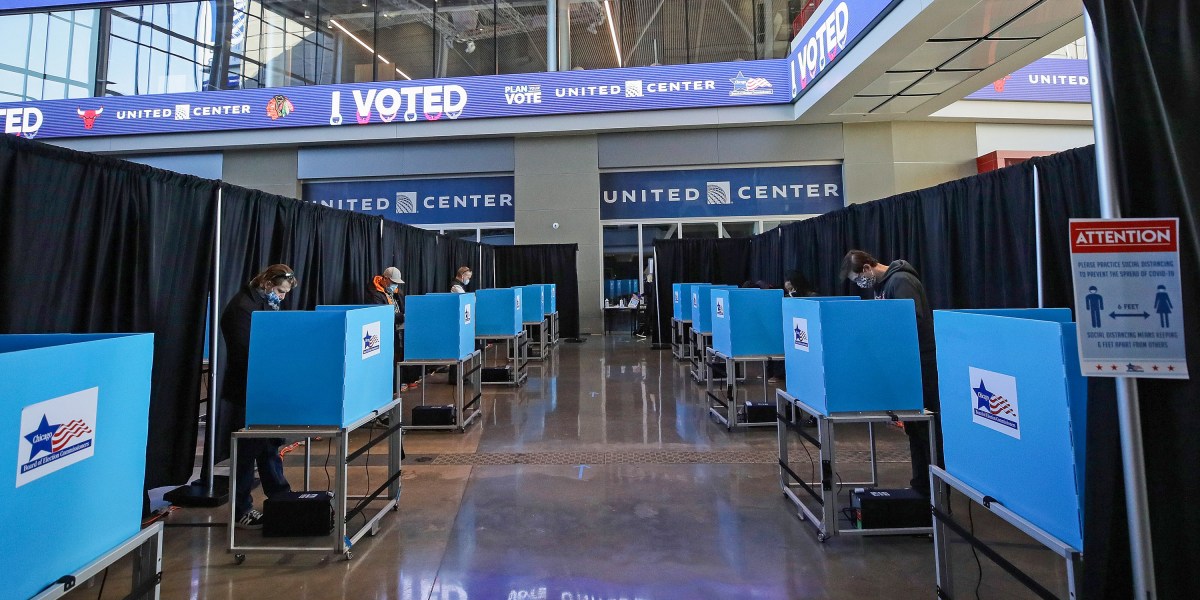
Back in Concord, Adida appeared to be persuasive to the public at large — or at least those invested enough to attend the event. Of the 201 attendees who filled out a scorecard, VotingWorks was the most popular first choice. But among election officials, the clear preference was Dominion. Some officials were skeptical that open-source technology would mean much to people in their towns. “Your average voter doesn’t care about open source,” said one town clerk.
Still, five towns in New Hampshire have already purchased VotingWorks machines, some of which will be used in upcoming March local elections.
Two main factors determine whether someone has faith in an election, said Charles Stewart III, a political scientist at MIT who has written extensively about trust in elections. The first, which affects roughly 5 to 10 percent of voters, is a negative personal experience at the polls, like long lines, rude poll workers, and problems with machines, which can make the public less willing to trust an election’s outcome.
The second, more influential factor affecting trust is if a voter’s candidate won. That makes it supremely difficult to restore confidence, said Tammy Patrick, a former election official in Maricopa County and the current CEO for programs at the National Association of Election Officials. “The answer on election administration — it’s complex, it’s wonky, it’s not pithy,” she said in a recent press conference. “It’s hard to come back to those emotional pleas with what the reality is.”
Adida agrees with Stewart that VotingWorks alone isn’t going to eliminate election denialism — nor, he said, is that his goal. Instead, he hopes to reach the people who are susceptible to misinformation but haven’t necessarily made up their minds yet, a group he describes as the “middle 80 percent.” Even if they never visit the company’s GitHub, he says, “the fact that we’re putting it all out in the open builds trust.” And when someone says something patently false about the company, Adida can at least ask them to identify the incriminating lines of source code.
Are those two things — rhetorical power and a commitment to transparency — really a match for the disinformation machinery pushing lies across the country? Adida mentioned the myths about legacy vendors’ machines being mis-programmed or incorrectly counting ballots during the 2020 election. “What was the counterpoint to that?” he asked. “It was, ‘Trust us. These machines have been tested.’ I want the counterpoint to be, ‘Hey folks, all the source code is open.’”
Spenser Mestel is a poll worker and independent journalist. His bylines include The New York Times, The Atlantic, The Guardian, and The Intercept.
This article was originally published on Undark. Read the original article.
24World Media does not take any responsibility of the information you see on this page. The content this page contains is from independent third-party content provider. If you have any concerns regarding the content, please free to write us here: contact@24worldmedia.com

Do you believe the Covid vaccine had negative side effects? VOTE HERE

Latest Google layoffs hit the Flutter and Python groups

‘Women’s rights have been attacked constantly!’

Here’s your chance to own a decommissioned US government supercomputer

AWS S3 storage bucket with unlucky name nearly cost developer $1,300

FTC fines Razer for every cent made selling bogus “N95 grade” RGB masks

Apple confirms bug that is keeping some iPhone alarms from sounding

Roundtables: Inside the Next Era of AI and Hardware

Supplements: Ginkgo biloba boosts memory